
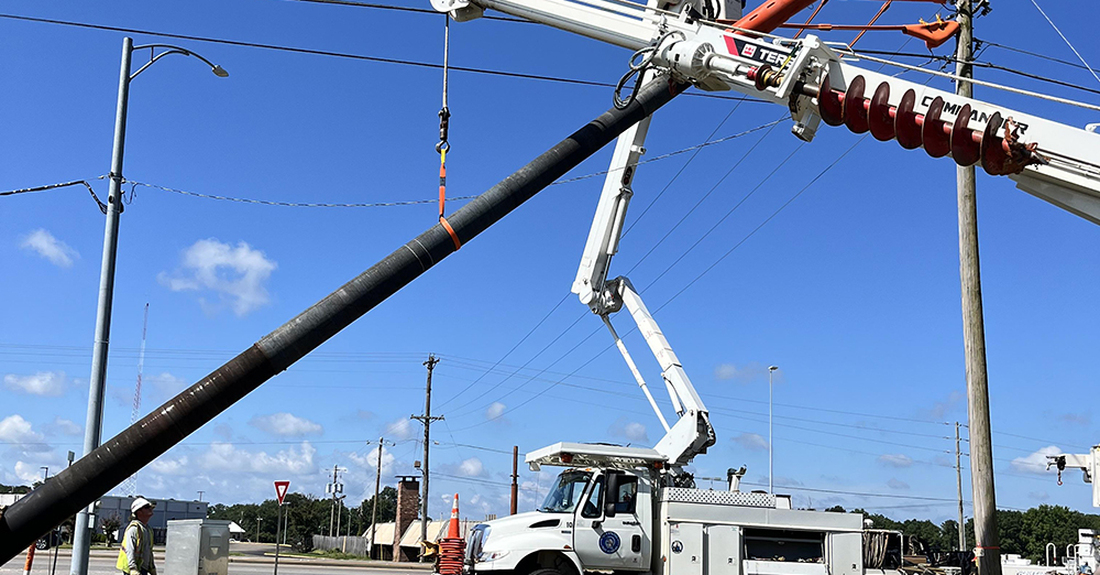
Strict construction requirements shape every detail of a power line pole before it ever reaches the field. Material choice, precision design, and engineering discipline play roles in how that structure performs over decades. Any oversight in the construction phase introduces risk, increases maintenance costs, and weakens infrastructure reliability.
Minimum Load and Strength Ratings
Every power line pole must meet load-bearing minimums during the construction phase before it enters service. Pole designers calculate vertical and horizontal loads by considering conductor tension, wind speed exposure, ice accumulation, and anticipated mechanical stress. Strength requirements apply equally to all pole materials, including wood, ductile iron, and composite, with distinct testing processes for each.
In the case of ductile iron, PLS analysis, destructive load testing, along with continued material strength testing confirms compliance with standards from the American National Standards Institute (ANSI) and the National Electrical Safety Code (NESC). Wood poles require careful selection based on species and grain quality to meet strength expectations, followed by mechanical proof loading for verification.
Deviation during construction—from wall thickness to fiber orientation—invalidates structural certification. Manufacturers follow strict construction requirements for power line poles to prevent failure under normal operating conditions and preserve grid safety.
The poles must hold up under fault current forces during short circuits or downed wires. In fire-prone or coastal regions, strength requirements increase to account for unpredictable environmental stress.
Pole Class, Dimensions, and Tapering
Many manufacturers, including McWane Poles, are deemed wood pole replacements and follow the utility pole classifications established by ANSI 05.1 for Grad B construction. These class designations reflect a pole’s minimum mechanical strength based on its length and intended load. Engineers use class to define how much load a pole can support.
Wood poles require uniform tapering to maintain consistent strength along the length, while ductile iron and composite poles achieve similar load profiles using engineered tapers or constant-diameter designs.
Material differences require separate methods to achieve compliance with class specs. Composite poles have a layered fiber orientation to control strength and flexibility. Ductile iron poles use cast geometry and wall thickness precision to meet their class load minimum strength. Wood poles, by contrast, depend on species selection and careful lathe shaping during construction to match required ratings.
Ground Line Treatment and Material Protection
Meeting construction standards requires durable protection at the ground line, where moisture, decay, and corrosion strike most aggressively. Wood poles receive pressure treatment with preservatives, to reduce the likelihood fungal breakdown and insect activity. Ductile iron poles gain additional ground line protection by applying a ceramic epoxy coating from the base of the pole to the customers desired location above the ground line. Unlike other metallic pole products, the epoxy is applied internally as well.
Composite poles rely on resin systems and UV-blocking outer shells to protect against moisture and sun exposure. Each material demands a unique approach to defend the ground line after installation. Ground line vulnerability is one of the top causes of pole failure, especially in regions with high water tables or intense freeze-thaw cycles.
Protective treatment also plays a role in long-term performance. Inadequate or inconsistent coating leads to uneven degradation and premature replacement. In wood poles, corrosion and rot rarely start at the surface; they begin where materials absorb stress, water, and heat.
Bolt Patterns and Attachment Hardware Integration
Every power line pole must accommodate precise bolt patterns to secure crossarms, insulators, and grounding systems without structural compromise. Wood poles allow for field drilling, but manufacturers may construct them with pre-marked zones to avoid knot clusters or weak points. Composite and ductile iron poles can also be drilled in the field, but construction crews prefer the poles to arrive with pre-drilled hardware holes, which must align with utility-approved templates.
National standards control the spacing, angle, and penetration depth of every hardware connection point to avoid overstressing the pole wall or creating torsion points. Hardware misalignment is one of the leading reasons poles fail under unbalanced conductor loading.
Precision bolt placement is a critical construction requirement for power line poles, especially for ductile iron and composite designs. Field crews depend on predictable anchor points to avoid rework or dangerous adjustments at elevation. Accuracy during the manufacturing phase eliminates delays and supports reliable performance.
At McWane Poles, you can find ductile iron power distribution and transmission poles with holes drilled into the structure per the customers drill guide, eliminating issues with shifting brackets or warping. Ductile iron retains dimensional stability under loads, temperature swings, or long-term vibrations.
In comparison, composite poles offer similar consistency but require additional inserts to achieve the same connection strength. Every detail built at the plant supports success in the field.
Drilling, Boring, and Field Modifications
Construction standards address when and how utility workers may drill or modify poles after manufacturing. Ductile iron poles arrive pre-drilled per the submitted drilling design. Ductile Iron poles can also be field drilled to accommodate changes or angle adjustments that are required. Composite poles discourage unauthorized field modification due to fiber orientation and bonding integrity concerns.
Wood poles are the most flexible in terms of field changes, but they come with drilling limits and reinforcement requirements. Construction guidelines dictate acceptable hole sizes, spacing, and offset distances to preserve strength. Deviating from those specs—especially in load-bearing areas—can reduce pole lifespan or create structural risks.
Manufacturers design poles with future accessories in mind. Pre-installed inserts, adjustable brackets, and flexible drilling zones improve installation efficiency and avoid on-site improvisation. Utilities that follow construction standards reduce guesswork, protect safety, and extend asset longevity.
Fire Resistance and Heat Tolerance Standards
Utilities in wildfire-prone regions must meet construction standards for fire resistance and thermal performance. Wood poles may receive fire-retardant coatings or barrier wraps, but those solutions wear down over time and require reapplication. Ductile iron poles are inherently heat resistant and retain structural integrity under extreme temperatures.
Composite poles perform well in fire zones when constructed with heat-resistant resins and treated exterior sheaths. Construction methods include additional curing cycles or post-fabrication treatments to meet regional ratings. National Fire Protection Association (NFPA) guidelines and utility-specific codes define minimum exposure thresholds for pole materials.
Manufacturers can test poles using direct flame, sustained heat, and thermal shock protocols to confirm performance. Ductile iron passes these tests with ease, offering a zero-combustion option for infrastructure routes. Composite options perform well in most cases but can lose strength once exterior layers sustain damage.
Choosing poles that meet fire resistance standards from the ground up simplifies permitting, reduces insurance costs, and increases community trust. Construction decisions made early protect equipment and the communities that depend on uninterrupted power.
Utility companies that prioritize precision during construction avoid premature failure, reduce maintenance costs, and deliver more reliable service. Contact McWane Poles to learn how our ductile iron designs eliminate weaknesses of wooden infrastructure while offering lasting advantages over composite structures.